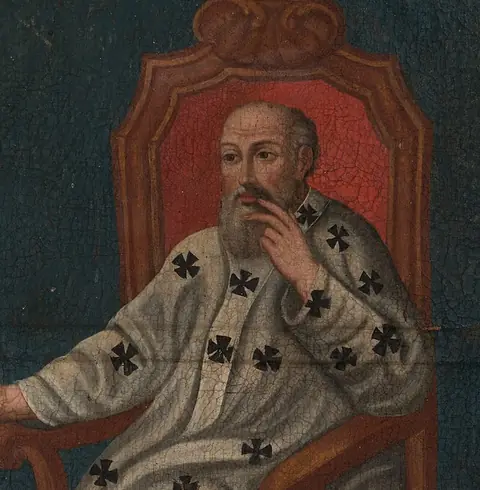
Ambrose of Milan (c. 339–397) was bishop of Milan and ranks among the great Latin Fathers and Doctors of the Church. A leading defender of Nicene orthodoxy against Arianism, he asserted the Church's independence from imperial power, establishing that the Christian emperor stands subject to the moral judgment of the Church.
Born into the family of a Roman prefect of Gaul and reared in Rome, he became governor of Aemilia-Liguria around 370, residing at Milan. In 374, while still only a catechumen, he was acclaimed bishop by popular demand, baptized, and consecrated within days. He firmly opposed Arianism, imposed public penance on the emperor Theodosius after the massacre at Thessalonica, and baptized Augustine.
His principal writings include On the Duties of the Clergy, the treatise On the Holy Spirit, and instructional works on the Mysteries and the Sacraments, alongside dogmatic compositions on the faith and repentance. He was also a reformer of Church music, introducing antiphonal singing and composing hymns that bear his name.
He died at Milan in 397 and was buried in the Ambrosian basilica beside the martyrs Protasius and Gervasius. Venerated as a saint, he is commemorated in the Orthodox Church on 7 December.