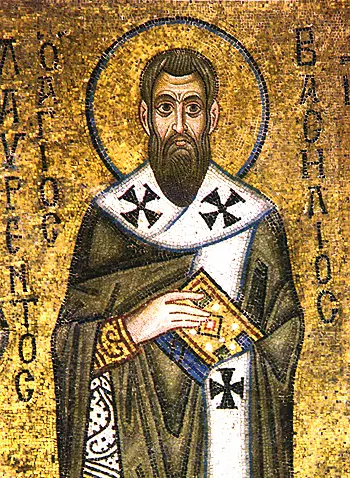
Saint Basil the Great was archbishop of Caesarea in Cappadocia and, with Gregory the Theologian and his own brother Gregory of Nyssa, one of the three Cappadocian Fathers; he is also numbered among the Three Holy Hierarchs and was a leading defender of Nicene orthodoxy against Arianism.
Born around 330 into a family that produced several saints, he studied at Caesarea, Constantinople, and Athens — where he formed a lifelong friendship with Gregory the Theologian — before giving away his wealth and embracing the monastic life. As archbishop of Caesarea he defied the Arian emperor Valens and organized monasticism on communal lines.
He founded charitable institutions for the poor, the sick, and travelers, and his Longer and Shorter Rules shaped Eastern monastic life. Among his works are the treatise On the Holy Spirit, the books Against Eunomius, the Hexaemeron homilies on the six days of creation, and a large body of letters; the Divine Liturgy of St Basil is still served on appointed days.
He died on 1 January 379. Venerated as a saint and one of the Three Holy Hierarchs, he is commemorated on 1 January and on 30 January with Gregory the Theologian and John Chrysostom.