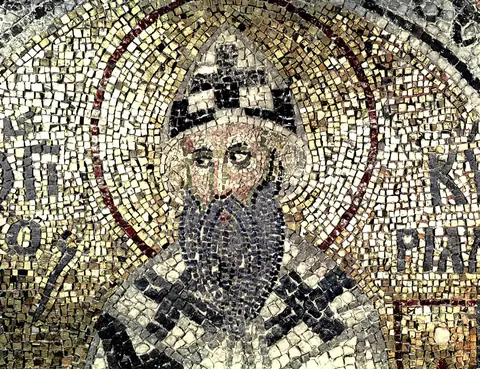
Saint Cyril of Alexandria (c. 376–444) was patriarch of Alexandria and the foremost Greek theologian of the early fifth century. A central figure of the Christological controversies, he was the chief defender of the title Theotokos, “God-bearer,” for the Virgin Mary, insisting on the unity of the divine and human in the one person of Christ.
Raised and educated by his uncle Theophilus, patriarch of Alexandria, Cyril succeeded him on the patriarchal throne in 412. He led the opposition to Nestorius, patriarch of Constantinople, whose teaching he judged to divide Christ, and presided over the Third Ecumenical Council at Ephesus in 431, which affirmed the unity of Christ and condemned Nestorianism.
His principal works include commentaries on the Gospels of John and Luke and on the Old Testament, the treatise On the Unity of Christ, dogmatic writings against Nestorius, and a major reply to the emperor Julian's polemic against Christianity.
Cyril died in 444. He is venerated as a saint and a Doctor of the Church; the Orthodox Church commemorates him on 18 January, a joint feast with Athanasius of Alexandria, and on 9 June, the day of his repose.
Complete known works in the Clavis catalog — 0 of 2 are in the archive (✓). The catalog is drawn
from Wikidata and the Patristic Text Archive, and covers only part of the
printed Clavis.
Saint Cyril of Alexandria’s corpus spans CPG 5200–
5438 (~239 numbers); we have detail for 2 and host 0.
· De adoratione et cultu in spiritu et
ueritate · not yet in the archive
· Glaphyra on the Pentateuch · not yet in the archive
Canon data: Wikidata (CC0) and the Patristic Text Archive / BBAW (CC BY-SA 4.0).