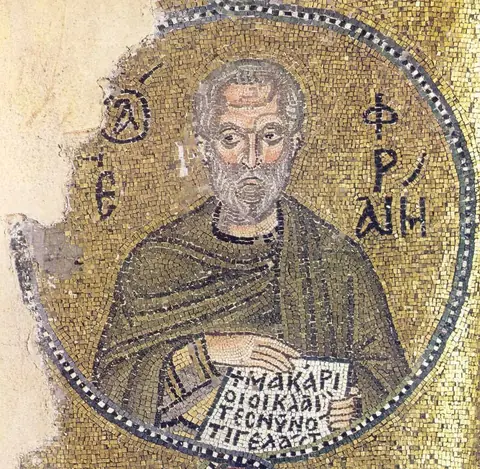
Saint Ephraim the Syrian (c. 306–373) was a fourth-century Syriac deacon, hymnographer, and teacher of the early Church. Writing entirely in Syriac, he became the foremost Christian poet of the patristic age and was later honored as a Doctor of the Church, gaining the byname “Harp of the Holy Spirit” for the abundance and beauty of his sacred verse.
Born at Nisibis in Mesopotamia, he served the Church there as a disciple and deacon under Bishop James of Nisibis. After Nisibis was ceded to Persia in 363 he settled at Edessa, where he taught, ministered to the poor, and organized famine relief; he remained a deacon throughout his life, declining higher office.
His enormous output comprises metrical hymns (madrashe) and verse homilies (memre) on faith, the Nativity, paradise, and the refutation of heresies, alongside biblical commentaries. His penitential prayer, beginning “O Lord and Master of my life,” is recited throughout Great Lent in the Orthodox Church.
He died at Edessa in 373. He is venerated as a saint, and the Orthodox Church commemorates him on 28 January.
Complete known works in the Clavis catalog — 0 of 18 are in the archive (✓). The catalog is drawn
from Wikidata and the Patristic Text Archive, and covers only part of the
printed Clavis.
· De virtutibus et vitiis · not yet in the archive
· CPG 3908 · not yet in the archive
· Περὶ φόβου ψυχῶν · not yet in the archive
· Λόγοι παραινετικοὶ πρὸς τοὺς κατ’ Αἴγυπτον μοναχούς · not yet in the archive
· CPG 3946 · not yet in the archive
· Sermo de sacerdotio · not yet in the archive
· De caritate · not yet in the archive
· Περὶ ψαλμοῦ · not yet in the archive
· De oratione · not yet in the archive
· CPG 3984 · not yet in the archive
· CPG 4002 · not yet in the archive
· De paenitentia · not yet in the archive
· CPG 4014 · not yet in the archive
· CPG 4015 · not yet in the archive
· De paenitentia · not yet in the archive
· CPG 4111 · not yet in the archive
· CPG 4112 · not yet in the archive
· CPG 4114 · not yet in the archive
Canon data: Wikidata (CC0) and the Patristic Text Archive / BBAW (CC BY-SA 4.0).