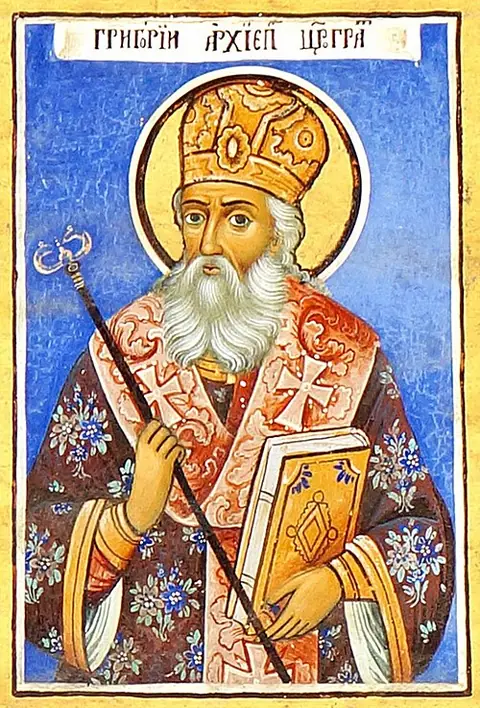
Saint Gregory of Nazianzus, called “the Theologian” — a title he shares only with the Evangelist John — was a Cappadocian Father, archbishop of Constantinople, and one of the Three Holy Hierarchs. His defense of the Trinity gave the Church some of its most precise dogmatic language.
Born around 329 near Nazianzus in Cappadocia, he studied at Athens alongside Basil the Great, with whom he shared the monastic life and compiled the Philokalia of Origen. Ordained reluctantly by his father, he was later summoned to lead the Nicene community at Constantinople, preaching in the chapel of the Anastasia.
At the Second Ecumenical Council in 381 his teaching on the three equal Persons of the Trinity prevailed; weary of ecclesiastical strife, he soon resigned the see and withdrew to his native region. His Five Theological Orations, together with his other orations, letters, and autobiographical poems, remain his enduring legacy.
He died in 390 at Arianzus, and his relics were later translated to Constantinople. Venerated as a saint and one of the Three Holy Hierarchs, he is commemorated on 25 January and on 30 January with Basil the Great and John Chrysostom.