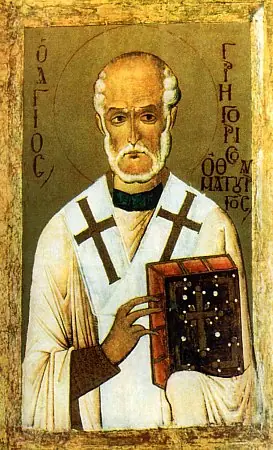
Saint Gregory the Wonderworker (Thaumaturgus) was bishop of Neocaesarea in Pontus in the third century, surnamed “the Wonderworker” for the many miracles attributed to him. A missionary bishop in a largely pagan region, he devoted his episcopate to the conversion of his city; by tradition he found only a handful of Christians there at his coming and left only a handful of pagans at his death.
Born into a prominent pagan family and trained for the law, he encountered Origen at Caesarea in Palestine while escorting his sister there, and studied under him, gradually being won to Christ. Returning to Pontus, he was made bishop of Neocaesarea and guided his flock through the Decian persecution and a time of plague.
His principal writings are a Declaration of Faith — a Trinitarian creed which tradition holds was revealed to him in a vision — the Panegyric (Address of Thanksgiving) to Origen, the Canonical Epistle on church discipline, and a paraphrase of Ecclesiastes.
He reposed at Neocaesarea about 270. Venerated as a saint, he is commemorated in the Orthodox Church on 17 November.