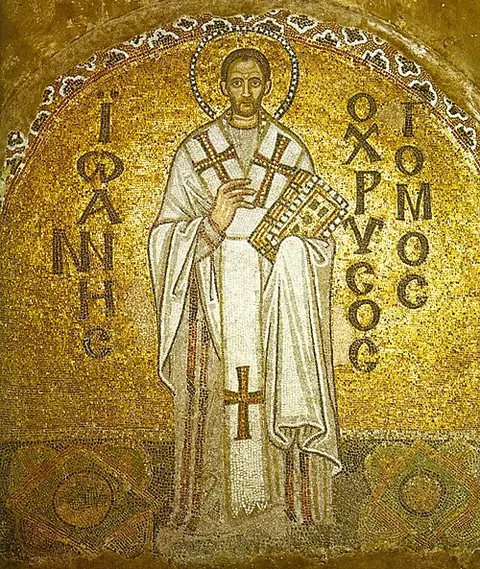
Saint John Chrysostom was archbishop of Constantinople and the most celebrated preacher of the Greek East, whose eloquence earned him the surname “Chrysostom” — “golden-mouthed.” One of the Three Holy Hierarchs, he is honored as among the greatest interpreters of Scripture in the Eastern Church.
Born at Antioch around 347, he was trained in rhetoric under the pagan orator Libanius before devoting himself to Scripture and the ascetic life. Ordained deacon and then priest at Antioch, he won fame as a preacher, and in 397 was called to the see of Constantinople, where he set about reforming the clergy and the life of the court.
His denunciations of the misuse of wealth and of the excesses of the capital, including the empress Eudoxia, led a synod under Theophilus of Alexandria to depose him, and the emperor sent him into exile. He directed the revenues of his office to hospitals and hostels for pilgrims and labored to spread the faith beyond the city.
He died in 407 at Comana, on the road to a remoter banishment; his relics were returned to Constantinople in 438. He is commemorated on 13 November, on 27 January for the translation of his relics, and on 30 January with Basil the Great and Gregory the Theologian. His scriptural homilies and the Divine Liturgy that bears his name endure in the Church's life.
Complete known works in the Clavis catalog — 0 of 1 are in the archive (✓). The catalog is drawn
from Wikidata and the Patristic Text Archive, and covers only part of the
printed Clavis.
Saint John Chrysostom’s corpus spans CPG 4305–
5197 (~893 numbers); we have detail for 1 and host 0.
· Paschal Homily · not yet in the archive
Canon data: Wikidata (CC0) and the Patristic Text Archive / BBAW (CC BY-SA 4.0).