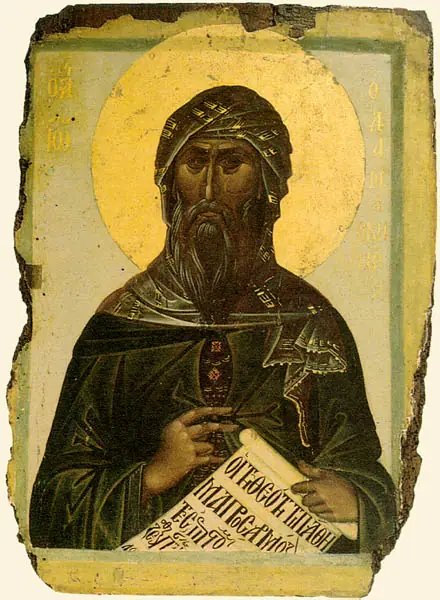
John of Damascus was a monk and priest of the eighth century, frequently called the last of the Greek Fathers. He stands at the forefront of the Iconoclast controversy as the foremost theological defender of the veneration of the holy icons against the iconoclast emperors. He was also a prolific hymnographer whose liturgical poetry shaped Eastern Christian worship.
Born into a prominent Christian family of Damascus under Muslim rule, the son of a court official, he himself served in the administration of the caliph. He later renounced public office for the monastic life, entering the monastery of Saint Sabas near Jerusalem, from which he composed his treatises defending sacred images against the policies of the emperor Leo III.
His principal work is the Fountain of Knowledge, whose third part, An Exact Exposition of the Orthodox Faith, became a foundational summary of Christian doctrine. He also wrote the three treatises on the divine images that secured his reputation, along with numerous hymns and liturgical canons still in use in the Church.
He died at the monastery of Saint Sabas about the year 749. He is venerated as a saint and was later named a Doctor of the Church; in the Orthodox calendar his memory is celebrated on 4 December.
Complete known works in the Clavis catalog — 0 of 4 are in the archive (✓). The catalog is drawn
from Wikidata and the Patristic Text Archive, and covers only part of the
printed Clavis.
Saint John of Damascus’s corpus spans CPG 8040–
8127 (~88 numbers); we have detail for 4 and host 0.
· An Exact Exposition of the Orthodox Faith · not yet in the archive
· Apologetic Treatises against those Decrying the Holy Images · not yet in the archive
· Artemii Passio · not yet in the archive
· CPG 8110 · not yet in the archive
Canon data: Wikidata (CC0) and the Patristic Text Archive / BBAW (CC BY-SA 4.0).