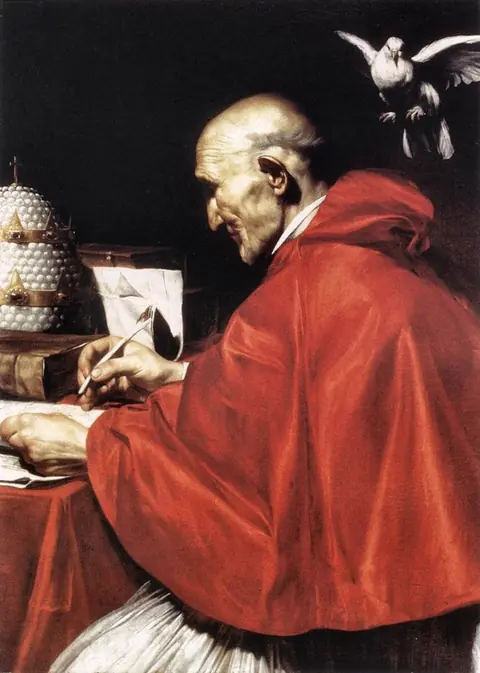
Saint Gregory the Great, called Gregory the Dialogist in the Orthodox tradition, was bishop (pope) of Rome from 590 to 604. Born at Rome around 540, he is among the most important figures of the early medieval Church and is counted a Doctor of the Church and the last of the traditional Latin Fathers.
Of senatorial rank, he served as prefect of the city of Rome before renouncing public life to become a monk, founding several monasteries with his inheritance. Sent as papal representative to Constantinople, he was elected bishop of Rome in 590; he reformed Church administration and dispatched the mission that converted the English.
His principal works include the Pastoral Rule on the office of the bishop, the Dialogues (from which his Eastern epithet derives), the Moralia on the Book of Job, and many homilies and letters. He is associated with the development of Church chant and, in the East, with the order of the Liturgy of the Presanctified Gifts.
He died at Rome in 604 and was soon acclaimed a saint. Venerated throughout the Church, he is commemorated in the Orthodox tradition on 12 March.
Complete known works in the Clavis catalog — 0 of 2 are in the archive (✓). The catalog is drawn
from Wikidata and the Patristic Text Archive, and covers only part of the
printed Clavis.
· Moralia in Job · not yet in the archive
· Dialogues · not yet in the archive
Canon data: Wikidata (CC0) and the Patristic Text Archive / BBAW (CC BY-SA 4.0).